Skip to content
VulnForge
the full catalog

Everything VulnForge does, in one place.

Ten feature categories. Every bullet is backed by code that ships today — check the repo if you want to inspect how any of it works.

01 · Paste a URL → reviewed finding

Core pipeline

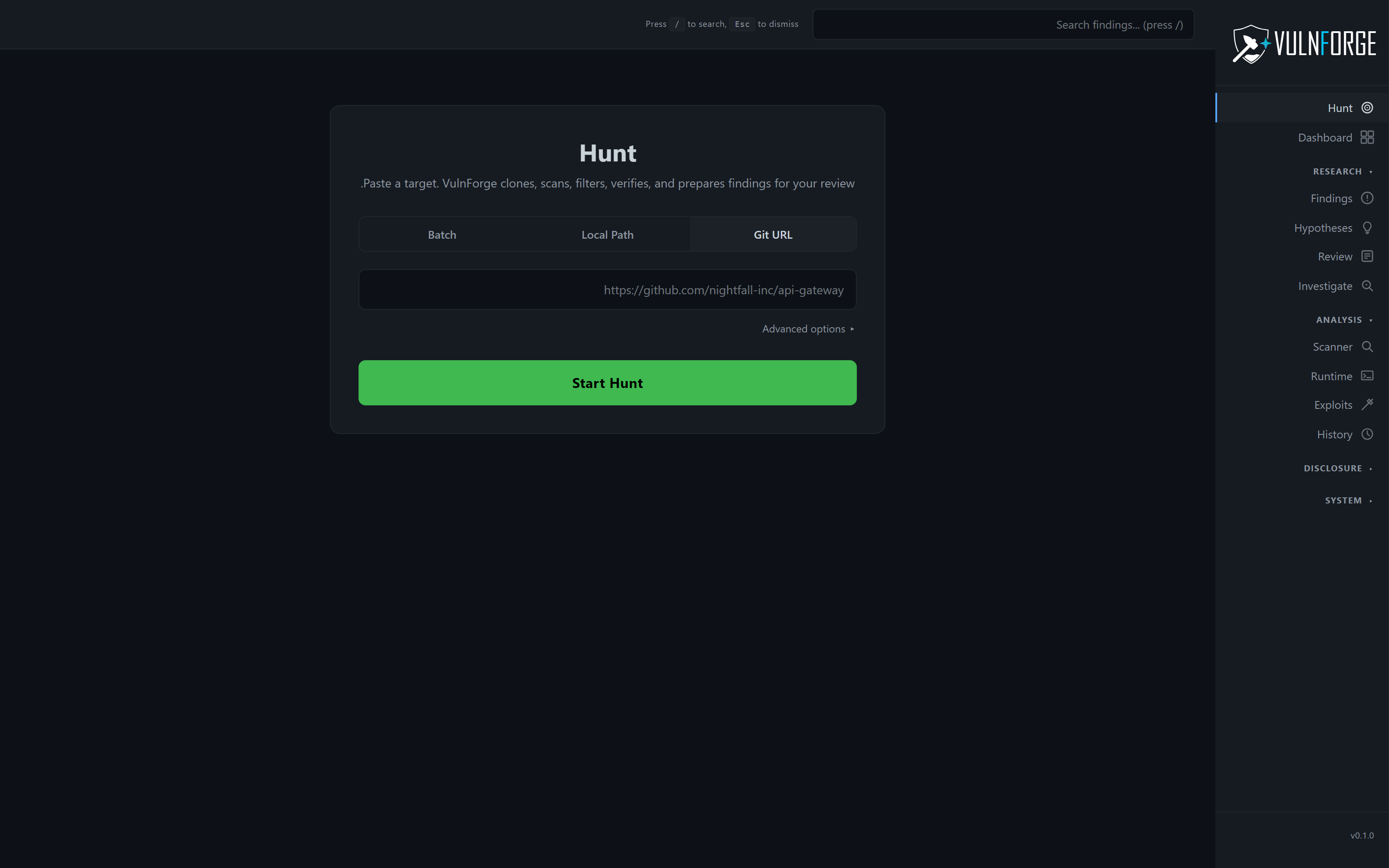
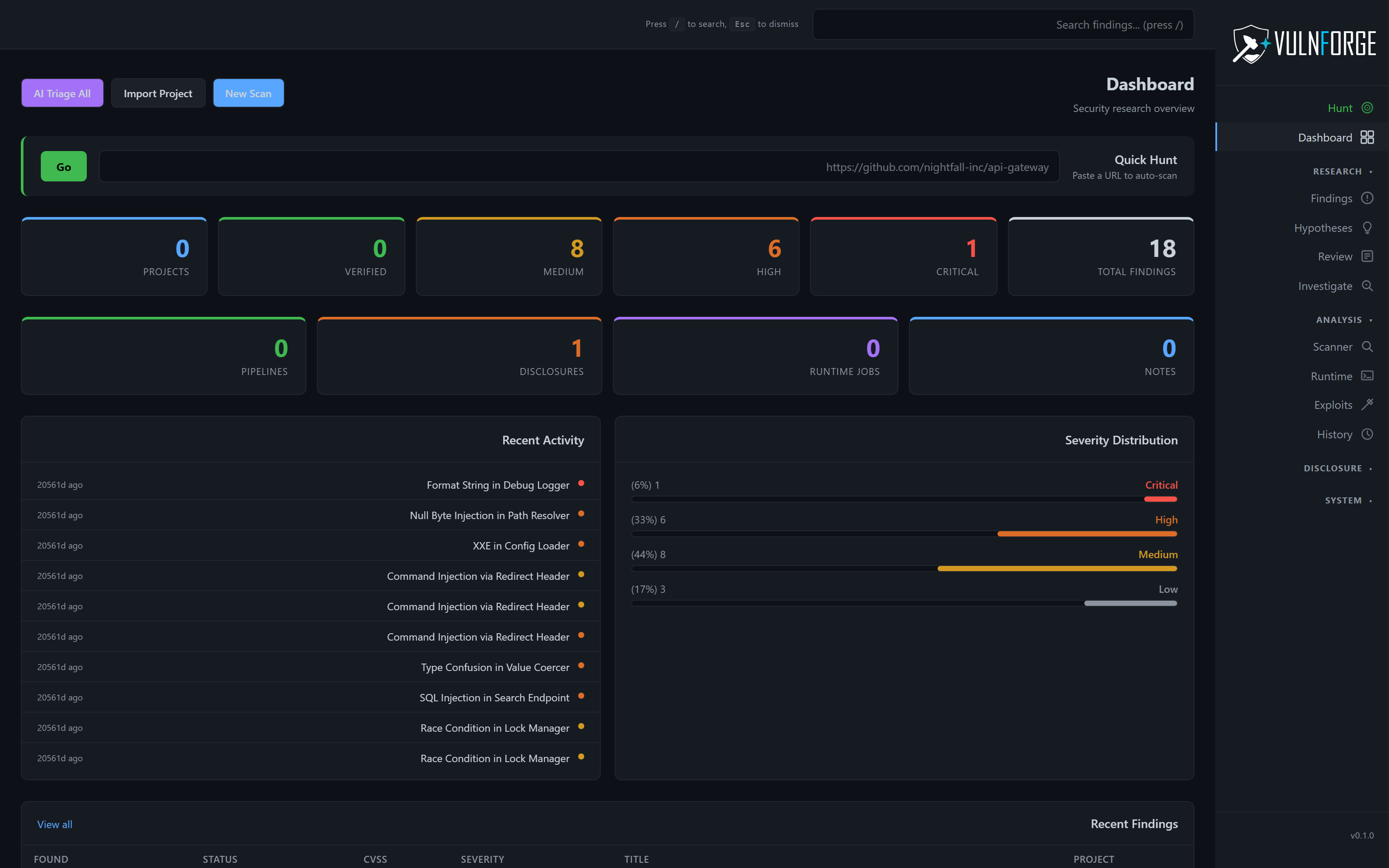
The autonomous pipeline handles the entire lifecycle. Clone, analyze, scan, filter, verify, and stage findings for review — all from one Git URL or local path. Pause mid-pipeline and resume later. Batch mode scans multiple targets in parallel. No-AI mode works out of the box.

  • Paste-a-URL huntsauto-detect language and pick the right tools
  • Pause / resumelong-running jobs survive restarts
  • Batch modeparallel multi-target
  • No-AI modeadd providers later
VulnForge Hunt page

02 · 48 Python tools + 10 plugins

Static analysis

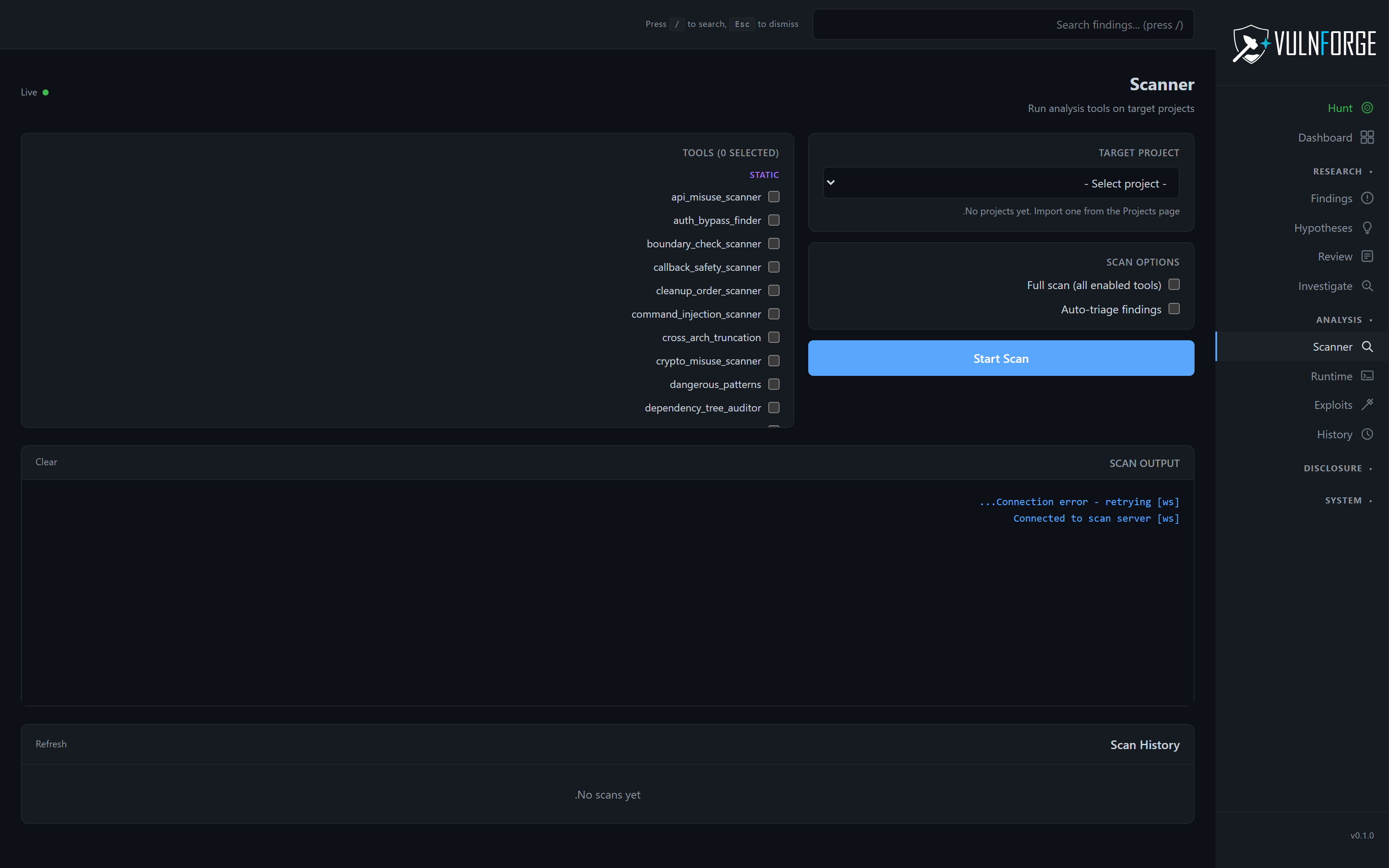
Memory safety, crypto, protocol, concurrency, supply chain — a curated 48-tool suite written for VulnForge, plus ten first-party plugin integrations of industry-standard scanners. Every finding flows through a 5-tier false-positive filter: dedup, reachability, heuristics, AI triage, confidence scoring.

  • 48 custom Python toolsbuilt for VulnForge's finding graph
  • 10 integrated pluginsSemgrep · Trivy · CodeQL · Nuclei · Grype · OSV-Scanner · Bandit · Safety · Nettacker · Garak
  • 17 CVE variant patternsmatched across every file
  • Config auditingDockerfile · CI/CD · .env · K8s
  • Attack surface mappingentry points · trust boundaries · pre-auth code
  • Dependency reachabilityfilter unreachable dep vulns via call graph
VulnForge Scanner page

03 · libFuzzer · gdb · Docker · QEMU · live capture

Runtime — live testing, VMs, sandboxes

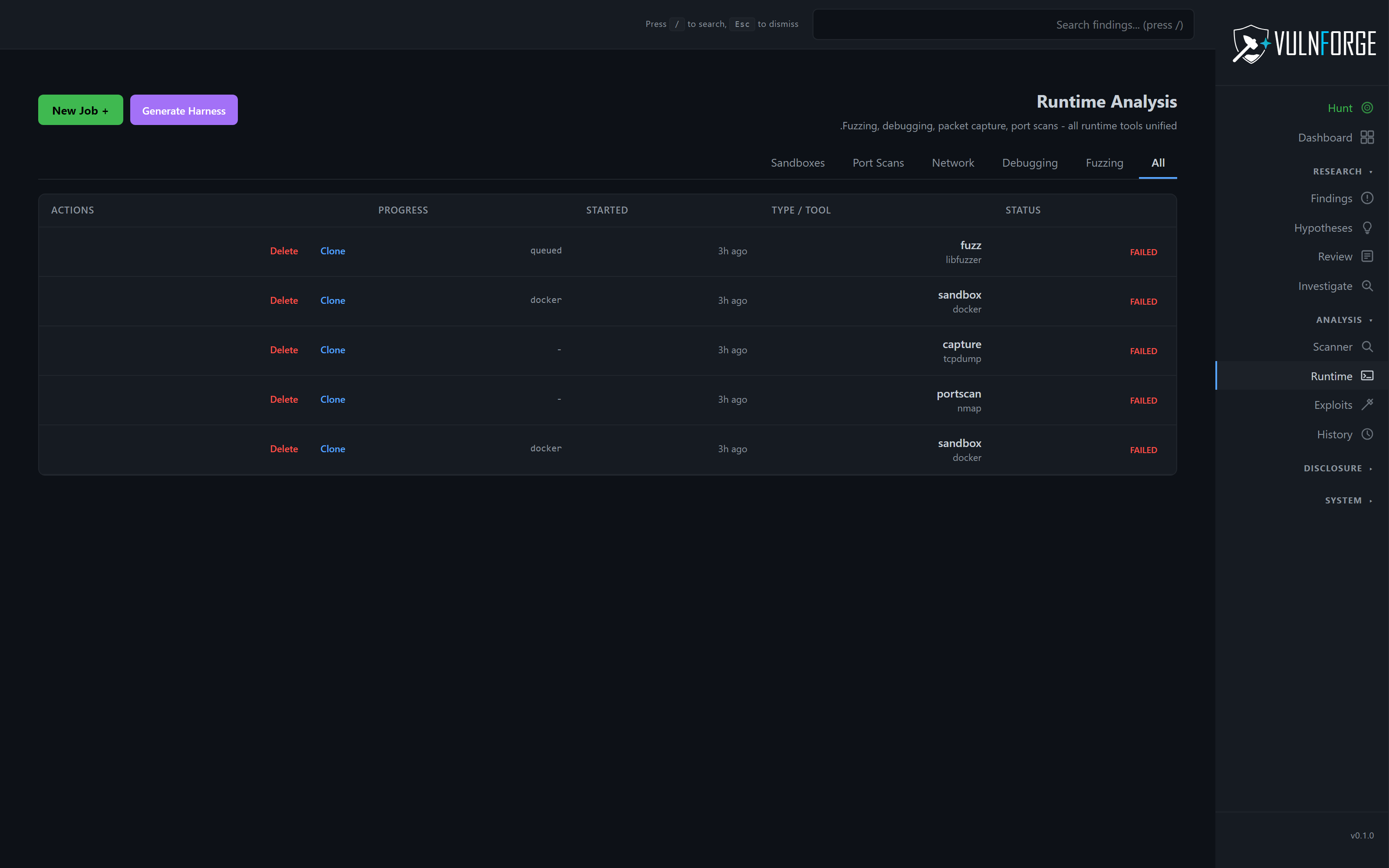
The Runtime page is where candidates become proofs. Drive any finding into a real, isolated environment without leaving VulnForge — fuzz the function, step through it in gdb, detonate the exploit in a disposable Docker container or full-system QEMU VM, capture the network traffic live, scan a host with nmap, or symbolically execute the binary. Every job streams output to the UI and MCP agents, pauses and resumes without losing state, and attaches its evidence directly to the finding. Ten executor types, one orchestration layer.

  • libFuzzerauto-generated harness from the function signature, ASAN+UBSAN, coverage-guided, minimized reproducers
  • gdb sessionsscripted breakpoints with assertion validation, persistent across restarts, attach or launch
  • Docker sandboxesdisposable containers, dropped caps, no-net by default, snapshot → run → rewind → export delta
  • QEMU full-system VMsboot a kernel, run the exploit, rewind with qcow2 snapshots, kernel-mode tracing
  • tcpdump + tsharklive capture, sliceable PCAP, protocol-anomaly feed into AI pipeline
  • nmaphost & service scanning with fingerprint matching
  • angr symbolic executioncraft inputs that reach a sink under constraints
  • radare2 / rizindisassembly, string xrefs, decompilation indexed for the investigator
  • Pause / resume / cancelevery job, including long-running fuzz runs, without losing state
  • MCP-drivableagents can spawn runtime jobs and read output via tools.call
VulnForge Runtime page — active fuzz, debug, sandbox, and capture jobs

04 · 5 providers · 7 presets · task routing

AI copilot

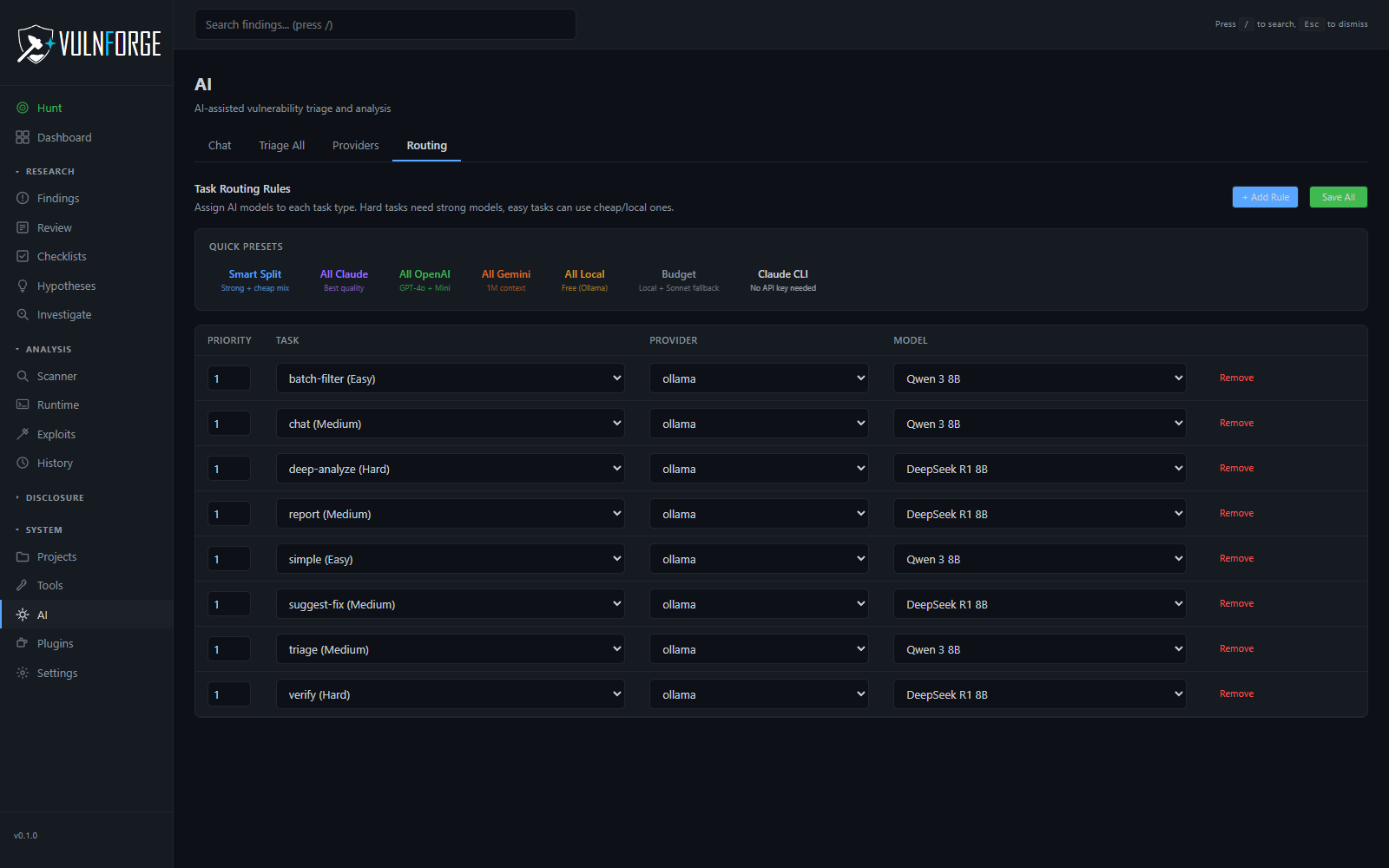
Claude, OpenAI, Gemini, Ollama, or Claude CLI — task-based routing with per-task fallback chains. Investigate mode runs step-gated interactive analyses. Assumption extraction lists all implicit assumptions in a function. Hypothesis generation suggests research directions. Auto-fallback kicks in on rate-limit exhaustion.

  • 5 providersClaude · OpenAI · Gemini · Ollama · Claude CLI
  • 7 routing presetsSmart Split · All Claude · All OpenAI · All Gemini · All Local · Budget · Claude CLI
  • Investigate modeinteractive, step-gated
  • Assumption extractionlist every implicit assumption
  • Hypothesis generationAI suggests research directions
  • Team-server proxykeys stay on the server
VulnForge AI page — task-routing matrix with 7 presets (Smart Split, All Claude, All OpenAI, All Gemini, All Local, Budget, Claude CLI) mapping tasks to providers and models

05 · Hypothesis board · notes · sessions

Research workspace

A persistent research journal with kanban board for hypothesis tracking (open → investigating → confirmed → disproved). Markdown notes with YAML frontmatter. Pluggable backends: local filesystem today, Obsidian vault today, Notion and Logseq planned. Quick-capture from anywhere with Ctrl/Cmd+N. Investigation context survives restarts.

  • Hypothesis board4-column kanban
  • Markdown notesYAML frontmatter, full-text search
  • Pluggable backendsLocal · Obsidian (Notion/Logseq planned)
  • Quick captureCtrl/Cmd+N from anywhere
  • Server-side sessioninvestigation context persists
VulnForge Hypothesis Board

06 · PoC workbench · proof ladder

Exploit development

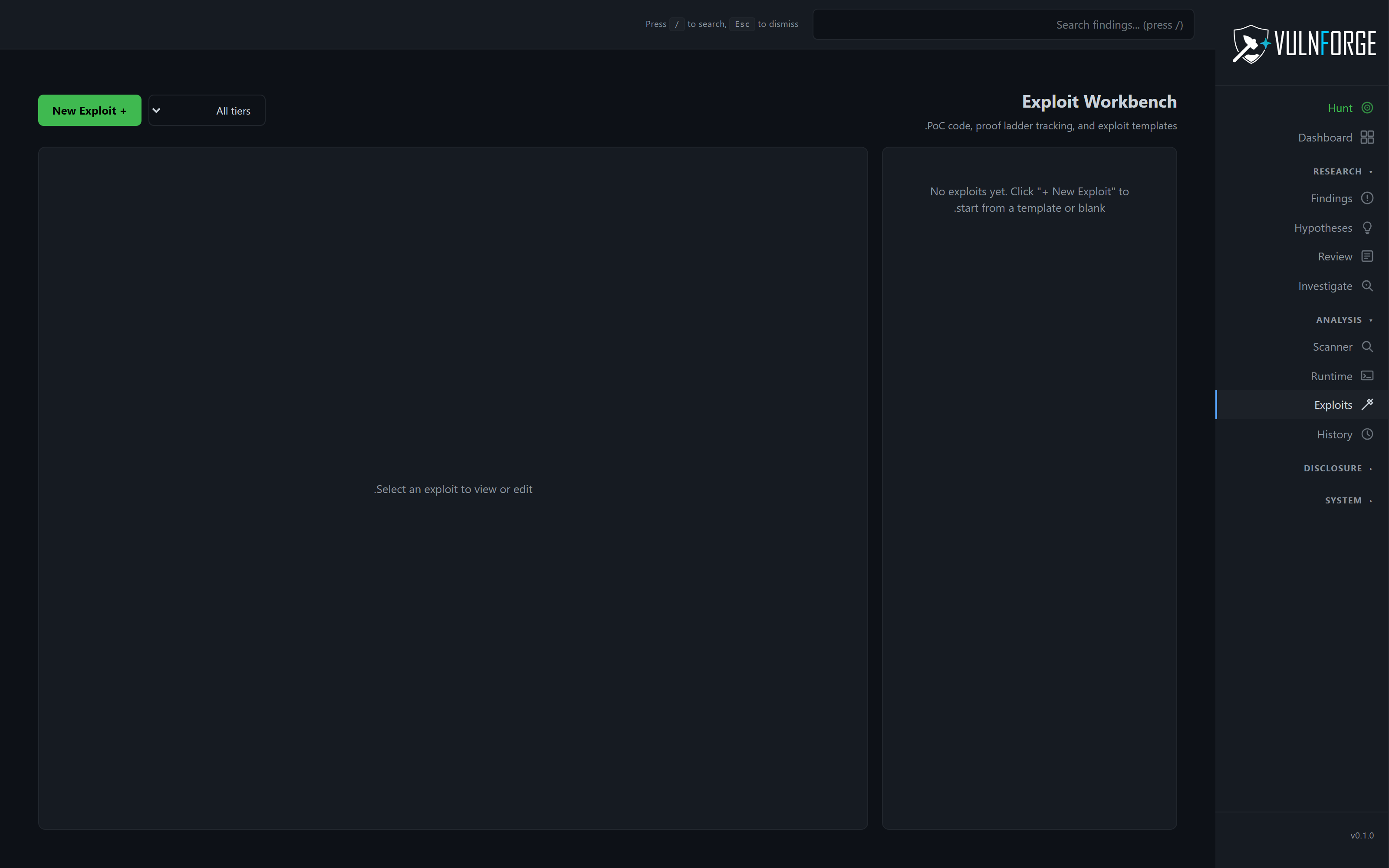
Write exploit code linked to findings in a PoC workbench. Advance each finding up a proof ladder: pattern → manual → traced → PoC → weaponized. Eight built-in exploit templates cover format string, buffer overflow, heap use-after-free, SQL injection, SSRF, and more.

  • PoC workbenchexploit code linked to findings
  • Proof ladder5 stages: pattern → weaponized
  • 8 exploit templatesFS · BoF · UAF · SQLi · SSRF · more
VulnForge Exploits page

07 · NVD sync · git bisect · patch analysis

Historical intelligence

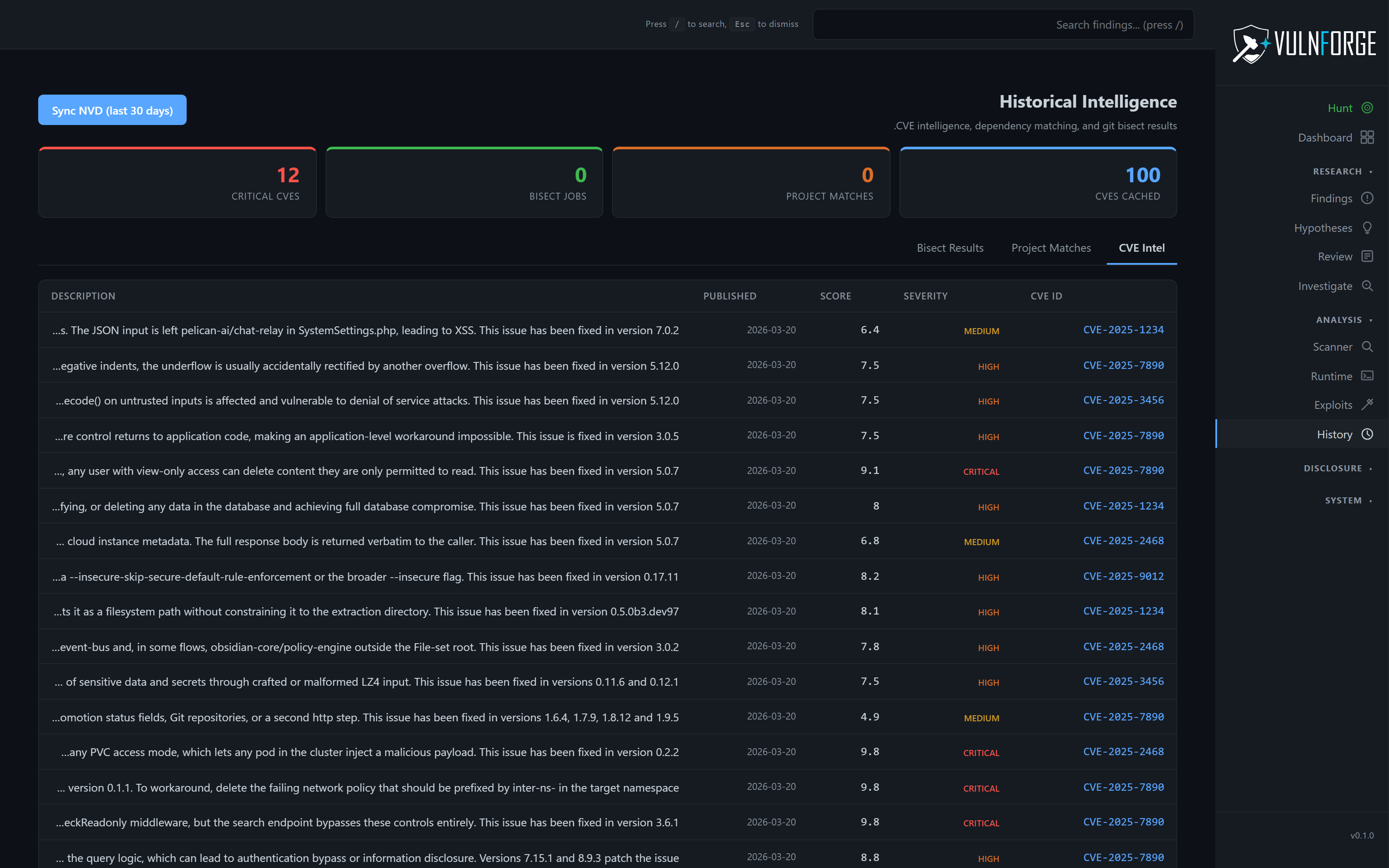
Sync CVEs from NVD and cross-reference against your target's dependencies. Use git bisect to pinpoint the commit that introduced a vulnerability. Extract patterns from historical security commits to power variant hunting.

  • NVD syncfetch CVEs, cross-reference deps
  • Git bisectpinpoint the bug-introducing commit
  • Patch analysisextract patterns from security commits
VulnForge Historical Intelligence — NVD sync, git bisect, patch analysis

08 · Jira · Linear · Trello · Slack · GitHub

Integrations & disclosure

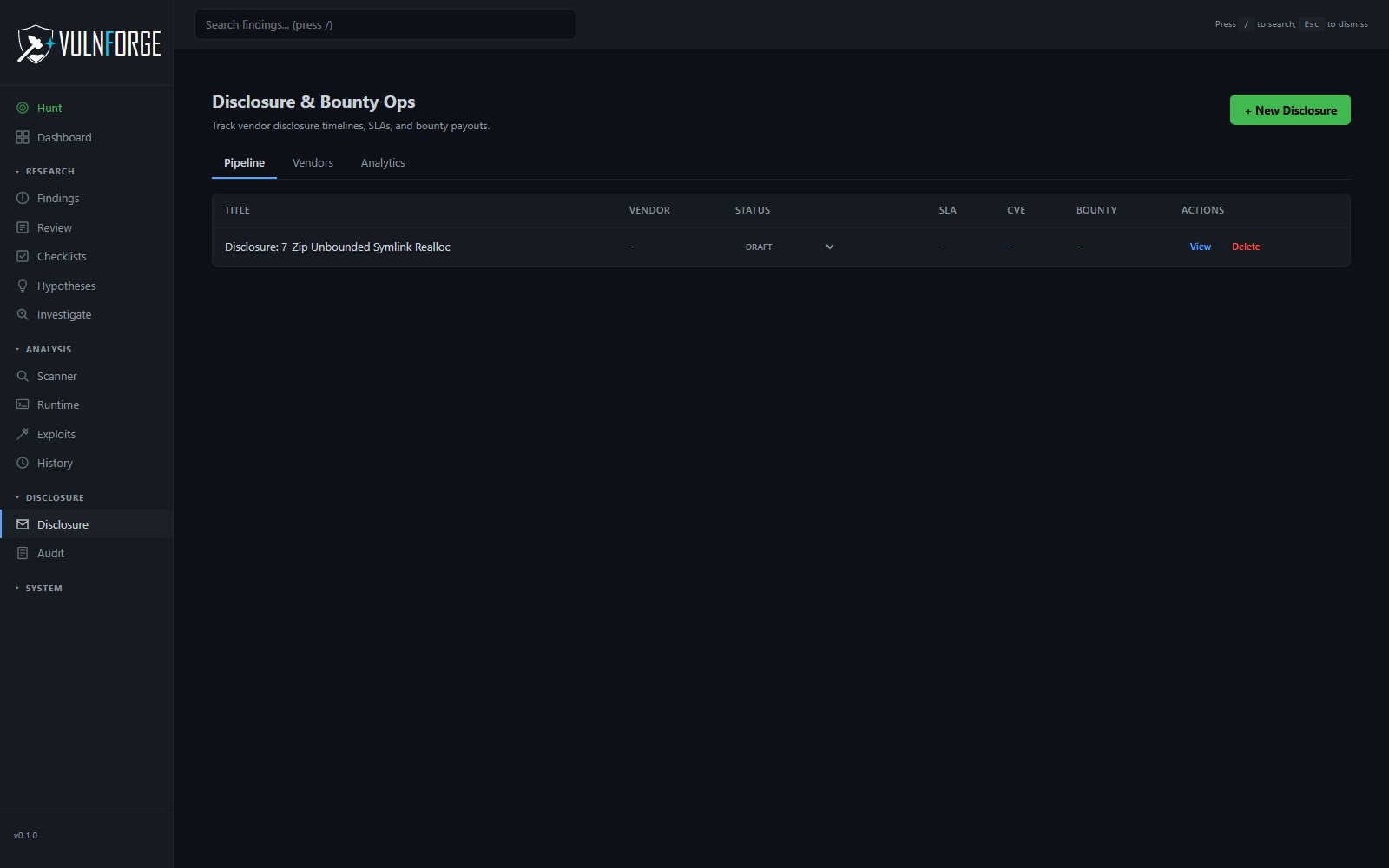
Full ticketing workflow: open, update, link findings to tickets across Jira, Linear, Trello, and GitHub Issues. Slack for messaging. Vendor management with contacts, platforms, and response times. SLA tracking with on-track / warning / overdue indicators. Bounty analytics: total payouts, averages, per-program ROI.

  • TicketingJira · Linear · Trello · GitHub Issues
  • MessagingSlack notifications & updates
  • Vendor managementcontacts · platforms · response times
  • SLA trackingon-track · warning · overdue
  • Bounty analyticspayouts · averages · per-program ROI
VulnForge Disclosure & Bounty Ops page — Pipeline, Vendors, and Analytics tabs with SLA status + CVE + bounty columns

09 · SARIF 2.1 · CVE JSON 5.0 · backups

Compliance & export

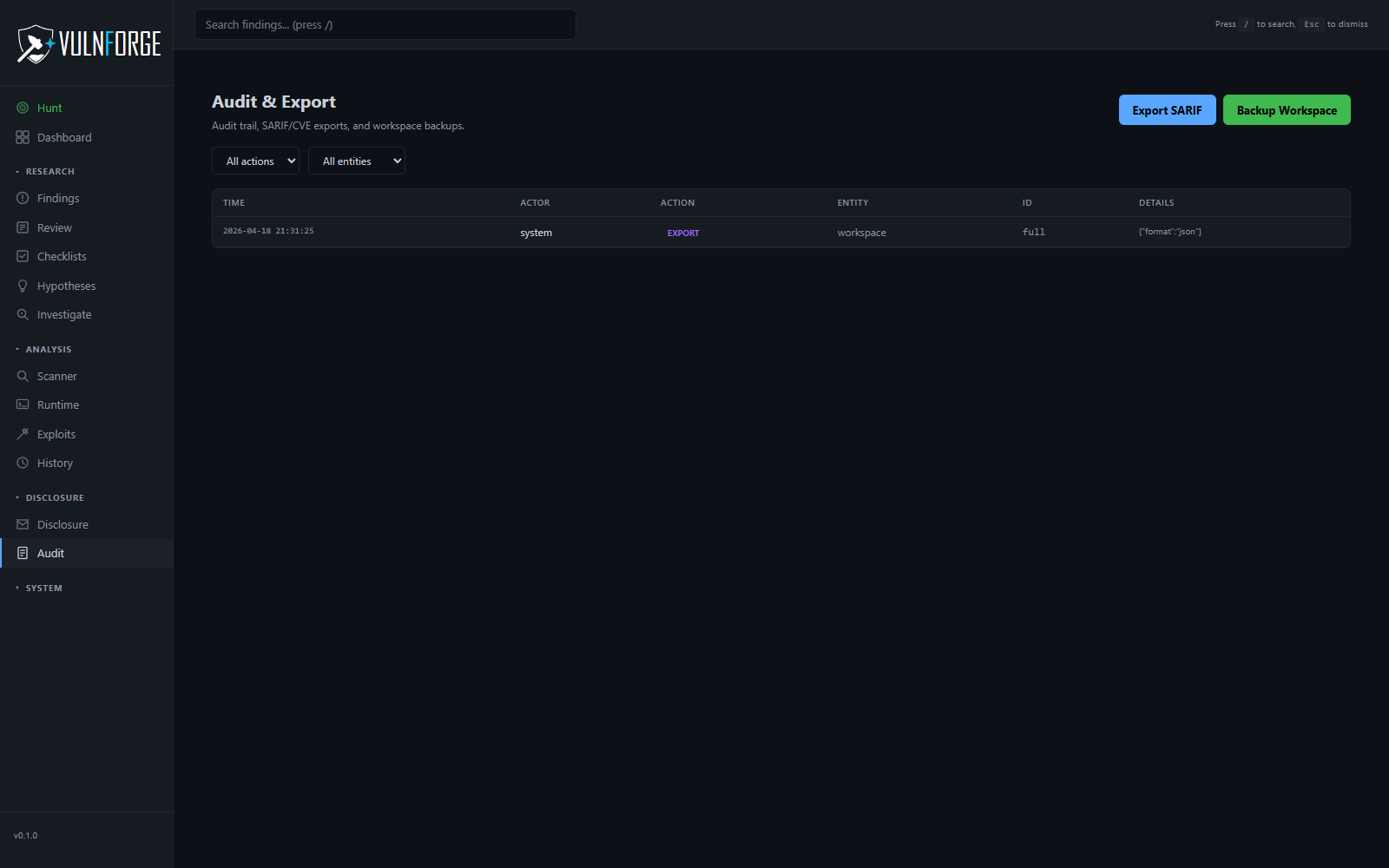
Export findings as SARIF 2.1 (compatible with GitHub, GitLab, and Azure DevOps security tabs) or CVE JSON 5.0 for CNA submission. Full workspace backup as JSON. Every action recorded in the audit trail.

  • SARIF 2.1GitHub · GitLab · Azure DevOps compatible
  • CVE JSON 5.0CNA submission format
  • Workspace backupfull JSON dump
  • Audit trailevery action logged
VulnForge Audit & Export page — Export SARIF + Backup Workspace buttons above a filterable audit log of every action

10 · Command palette · keyboard-first

Pro UX

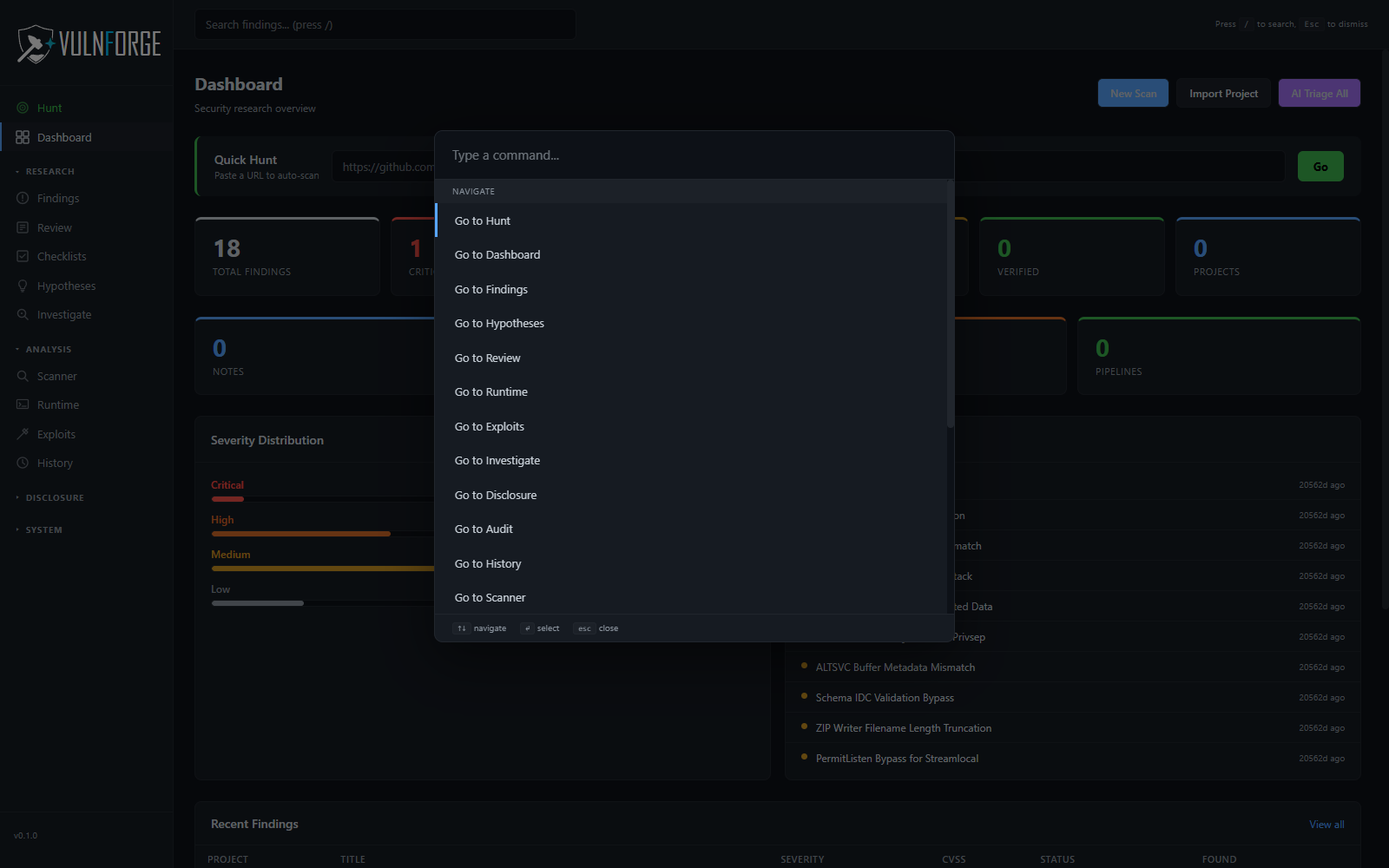
A command palette (Ctrl/Cmd+K) jumps to any of 22 pages. A keyboard-shortcut cheat sheet (press ?) shows everything at once. Grouped navigation collapses the sidebar into logical sections. The favicon matches your OS light/dark preference and updates live.

  • Command paletteCtrl/Cmd+K to jump anywhere
  • Keyboard shortcuts? for the full cheat sheet
  • Grouped navigation22 pages in collapsible sidebar
  • Theme-aware faviconlive OS light/dark switching
VulnForge command palette (Ctrl/Cmd+K) open over the dashboard — fuzzy-match navigation to every page